
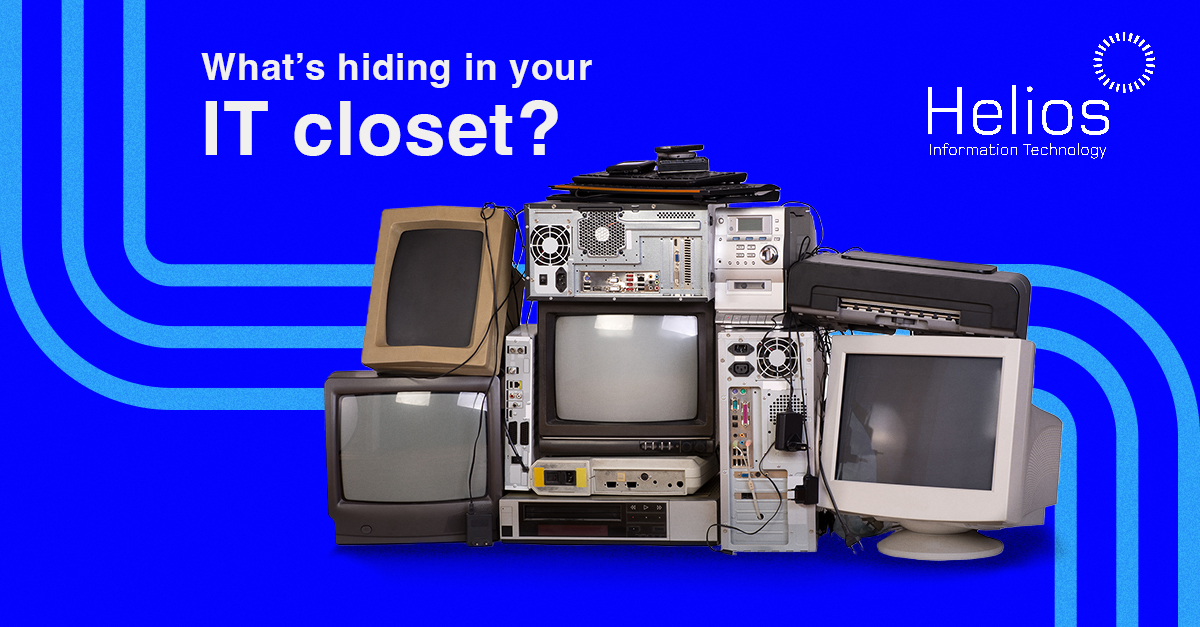
When was the last time you checked that closet you avoid?
It stays closed, nothing falls out, but you only open it when necessary. Inside are items you keep but do not really need, tossed in for convenience. It is crowded, not overflowing, and easy to forget.
IT clutter in businesses is similar—tidy on the surface, but messy and disorganised inside.
How Information Technology Clutter Accumulates Unnoticed
IT clutter often accumulates gradually and unnoticed. New tools are introduced to address specific challenges, additional systems are implemented as the organisation expands, and temporary solutions are employed during periods of increased activity to enhance efficiency. Legacy applications may remain operational because stakeholders are hesitant to remove software that continues to function.
Decisions seem logical individually, but without a holistic view, complexity grows unnoticed. Since nothing appears broken, simplification is neglected and small choices gradually create a tangled system.
Disorganised IT systems do not necessarily indicate failure. Often, they reflect the rapid pace of business growth and development.
What is often found in the IT closet?
In this post, when we mention IT closets, we are talking about them metaphorically—not actual closets—and they share a striking resemblance.
You will find:
- Tools that have fallen out of regular use
- Several systems duplicating tasks.
- Outdated software that persisted over time
- Access for former employees that has not been revoked.
- Temporary fixes that ended up being permanent solutions
This situation lacks any dramatic elements, which may lead to it being overlooked.
You are not the only one.
How unseen IT clutter can hinder business operations.
Clutter may not necessarily result in a visible disruption; rather, it tends to introduce subtle impediments.
Uncertainty about which system to use leads to delayed decisions, scattered information, wasted time on low-value tools, and unnoticed cost increases.
While each of these challenges may seem insignificant on their own, collectively they contribute to an increased burden in daily operations.
Clutter silently hinders business progress.
The danger of neglecting to clean Your IT.
Prolonged accumulation of clutter increases the difficulty of addressing it effectively.
Outdated systems are increasingly difficult to maintain. Old tools linger until a change makes them relevant, and workarounds persist even when their purpose is forgotten—yet the business relies on them.
Avoiding clutter only makes cleaning up harder later.
Neglecting regular reviews of systems and processes increases the risk of unexpected issues arising at inconvenient moments.
Spring cleaning your IT does not entail initiating operations from scratch.
Tidying up your IT closet does not require removing everything and beginning all over again.
Declutter purposefully: keep what is effective, organise what’s useful, and replace anything that no longer benefits your business.
The aim is not to cause disruption, but to promote clarity.
Creating space for development
Maintaining a clean IT environment enhances the workplace experience. The team can readily locate resources, systems facilitate decision-making rather than hinder it, and organisational changes are managed efficiently, minimising risk. Furthermore, growth occurs in a deliberate manner, rather than as a reaction to external pressures.
Managing clutter gives your business space to expand.
Begin by ensuring visibility.
It is not necessary to implement changes immediately.
Open the door and examine your IT environment to identify usage, overlaps, and neglected items.
Understanding must precede transformation.
If you want feedback, let us set up a brief discovery call to review what works, what does not, and any obstacles.